Proven foundations.
Independent products.
A software factory for .NET SaaS: shared, versioned kits for tenancy, identity, billing and operations, and products that ship on their own schedule. What one product learns, every product can adopt. Below is the real floor plan behind the products I run.
- Products
- 3 live · 2 in build
- Shared packages
- 19 · one version
- First commit to deployed dev environment
- ~2 days
- Lockstep upgrades
- 0
Tap a block, or pick one below.
From the factory log
- The cell: everything a product runs on, in one unit
- This site now builds on the design-system kit
- Image builds reuse their layers from the registry
- Security checks a product gets from the delivery kit
- From release to every live product in under an hour
- One delivery kit for two hand-kept pipelines
- A new look in the kit, pinned by Reputo and Leadgener
- One registry, checked against the repositories
How the factory works
Four rules, each one checkable.
A factory is only as good as the rules that keep it honest. These are the ones every product and every kit is held to.
Share what must not diverge
Security, legal requirements, operations and API contracts live in kits. Look, feel and domain are copied, then owned by each product.
Pin exactly
Every package and kit is pinned to an exact version. Every release says what a product must do to upgrade, and each product upgrades when its own pipeline is green.
Harvest, don’t design ahead
A kit starts as code already running in a product, ported faithfully and proved equal before anything is cleaned up.
People decide, machines verify
Scope, go-live and stopping are human calls. Builds, tests, drift and restores are checked automatically, with evidence.
The kits
Everything before your first feature.
Modular .NET packages, released together under one version, plus three kits versioned on their own: identity, design system and delivery. Each has a changelog that says exactly what an upgrade asks of you.
Multi-tenancy
Organization-as-tenant resolution, membership checks and a lifecycle gate for suspended or deleted tenants.
Tenancy.RuntimeOnboarding & organizations
From first login to a working organization with members and invites, plus a hook where the product checks its seat quota before an invite is created.
Onboarding.*Organizations.*Entitlements & usage
Feature flags, quotas and metered usage per organization, with access denied by default.
Entitlements.*Usage.*Billing
Stripe and Lemon Squeezy behind one abstraction, with idempotent webhook handling that skips stale events.
Billing.Providers.*Admin API
System-scope operations across organizations behind one gate, with refusals as RFC 9457 problem details carrying machine-readable codes.
Admin.ApiIdentity kit
A Keycloak base image pinned by digest, realm provisioning, and no token before the terms of use are accepted.
setuprequire-termsDesign-system kit
The interface core as an npm package: tokens, React components and lint rules. A product sets only its twelve brand colour roles; the kit checks ten of their colour pairs for contrast and keeps the interactive colours apart from the state colours.
brand.cssassertBrandDelivery kit
Seven GitLab CI/CD components and an ops image: tests with dependency scans, a secret scan, image builds, a deploy that backs up the database first and ends in a health gate, and a restore test into a throwaway container.
deployrestore-testNews
Latest from the factory
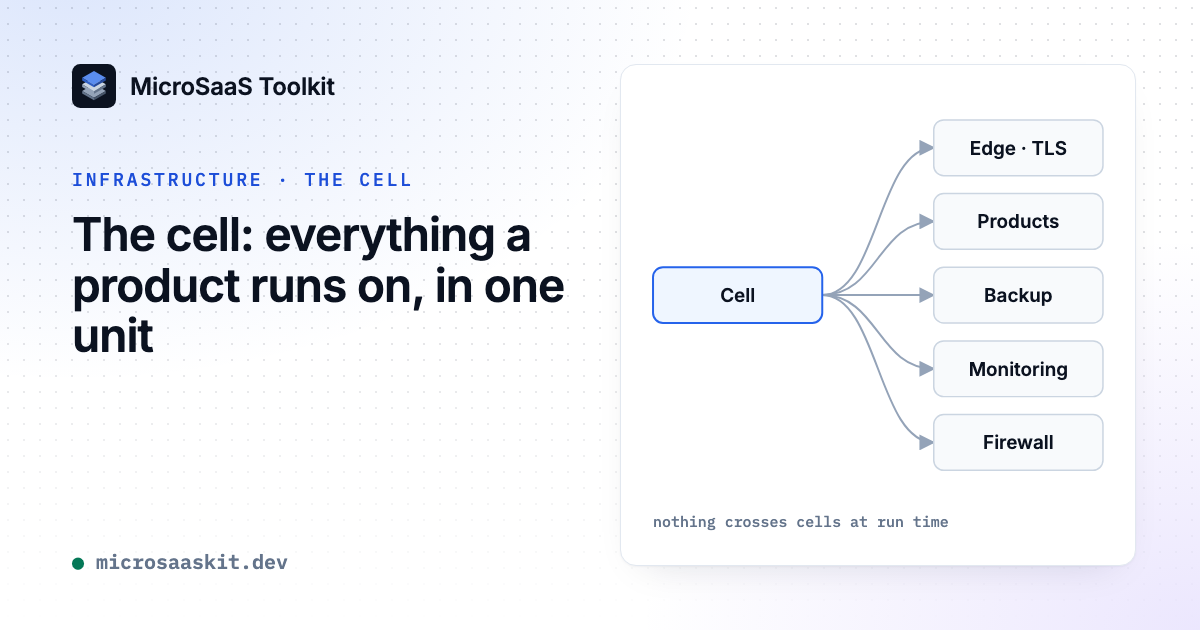
Infrastructure · 23 Oct 2026
The cell, our unit of infrastructure: built by one command in 1.7 minutes
By design, a cell is a self-contained unit, today one server, with everything a product runs on. The first one built by script ran a copy of a live product within 3.8 minutes.
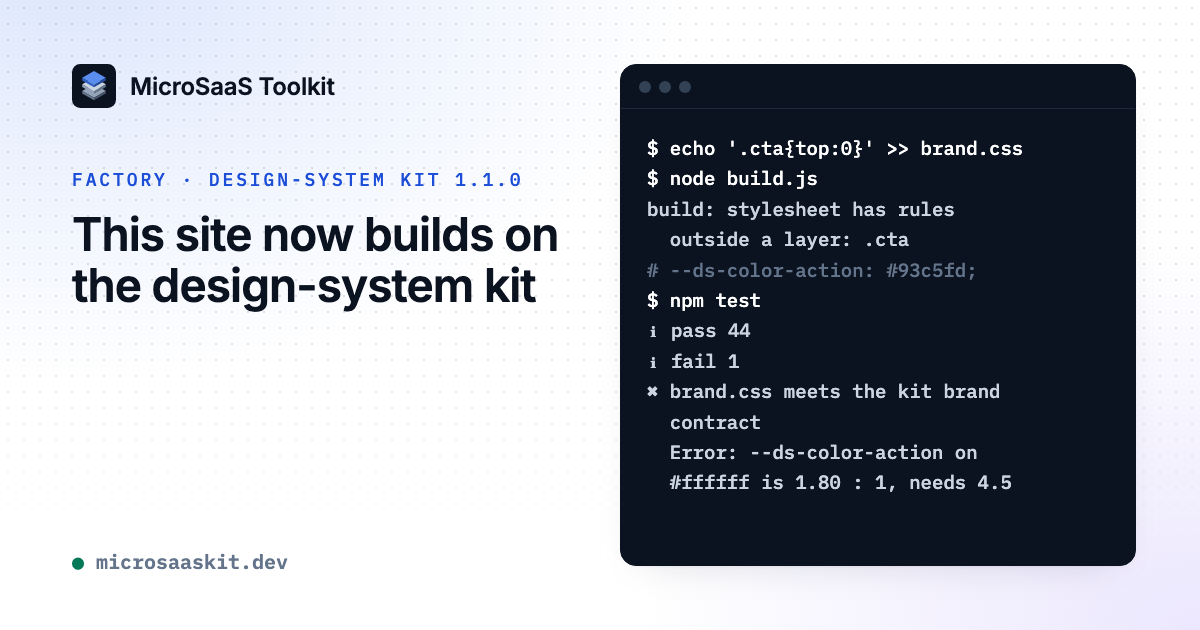
Factory · 21 Oct 2026 · microsaaskit.dev
The site that announced our design-system kit now builds on it
Since 21 October microsaaskit.dev pins design-system kit 1.1.0: our blue in twelve roles the kit checks, Tailwind inside the kit's cascade layers, and three checks that can stop the build.
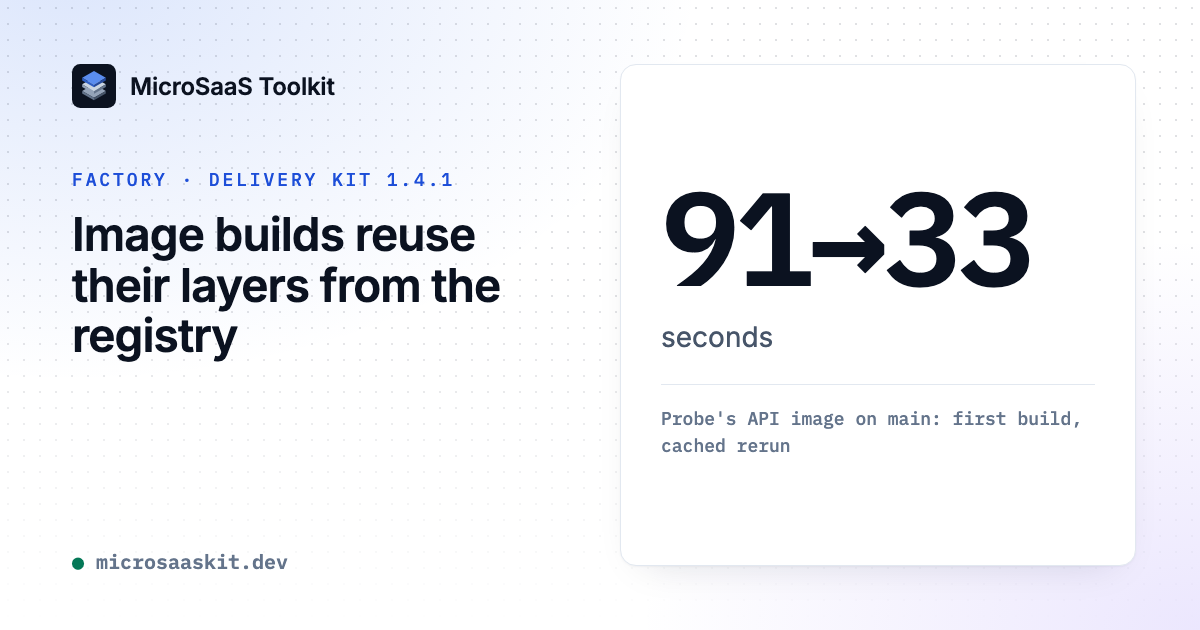
Factory · 20 Oct 2026 · Toolkit
A layer cache for image builds, and the canary that caught its first release
Delivery kit 1.4 lets an image build reuse its layers from the container registry. The first release failed on real runners; Probe caught it in a merge request before any other product pinned it.
FAQ
Short answers.
- What is MicroSaaS Toolkit?
- A software factory for .NET SaaS. It is a set of shared, versioned kits (19 NuGet packages for multi-tenancy, organizations and invites, onboarding, entitlements, usage metering, billing and an admin API, plus a Keycloak identity kit, a design-system kit and a delivery kit of CI/CD components) and the rules for running several independent products on top of them.
- Which products run on it?
- Three products are live: Gostly, guest messaging for short-term rental hosts; MojRazpis, alerts for Slovenian public tenders; and SnapMind, an AI memory for ideas, links and screenshots. Two more, Reputo and Leadgener, are in build.
- How do products upgrade when a kit changes?
- Every product pins an exact version, and every release says what a product must do to upgrade. Each product takes the upgrade when its own pipeline is green, so nothing upgrades in lockstep. A product registry tracks each one until production runs the new version.
- How long does it take to start a new product?
- About two days from the first commit to a deployed development environment with login: Leadgener took 45 hours, 13.5 of them a manual deploy job waiting overnight. A new repository starts from the reference product’s skeleton, pipeline and deploy, and pins the shared kits.
- Which billing providers are supported?
- Stripe and Lemon Squeezy, behind one abstraction, with idempotent webhook handling that skips stale events.
- Can I hire you to help?
- Yes. I offer architecture audits and reviews (tenancy, data isolation, upgrade paths), custom module development to the same release discipline, and infrastructure and CI/CD work. Write to jure.hrastnik@gmail.com.
Consulting
Work with the architect behind the factory.
I help teams adopt the toolkit, shape the architecture around their domain, or build the first version of a product on the same foundations.
- Architecture audit & review
Tenancy, data isolation, upgrade paths. - Custom module development
Built to the same release discipline. - Infrastructure & CI/CD
Pipelines, deploys, monitoring, backups.